
By Matt Yarbrough, Vice President of Policy & Government Affairs, Council for Quality Growth
North Fulton has spent decades establishing itself as one of Metro Atlanta's most important centers for jobs, business investment and economic growth. In the last decade or so, North Fulton has become a home to major corporations like ADP, Alcon, Boston Scientific, Fiserv, Morgan Stanley, Mercedes Benz and more. Not to mention a population of 393,166 with a labor force of 225,584. Growth like that does not happen on its own. It depends on the public infrastructure underneath it — the road network that connects employees to jobs, the bridges and intersections that move people safely, the sidewalks and trails that connect destinations and the transportation investments that allow communities to accommodate new development without sacrificing mobility or quality of life.
At the Council for Quality Growth, we see that relationship between transportation infrastructure, business development and economic investment every day. Our members may build offices, homes, retail centers and mixed-use communities, but the long-term success of those investments depends heavily on whether the surrounding infrastructure can keep pace. That is why the Council's transportation policy has focused on stable, dedicated funding for roads, transit, maintenance and safety, alongside Community Improvement Districts and other public-private partnerships that can turn those dollars into completed projects. Few commercial corridors across the metro region have been as successful as True North 400 in turning those dollars into real progress here in North Fulton, which is why TSPLOST III is so critical to our region’s success.
Virtually no significant transportation project in Metro Atlanta is funded from a single source. Major improvements often come from a combination of local sales-tax revenues, city capital funds, state transportation dollars, federal grants, Community Improvement District investments and private participation. Each source plays a different role. Local funding can advance design or right-of-way, provide the match necessary to compete for another grant, close a funding gap, or move a project far enough through development that state and federal partners can participate.
That funding stack is especially visible in North Fulton.
What TSPLOST Does
Fulton County's Transportation Special Purpose Local Option Sales Tax, or TSPLOST, is a dedicated 0.75% sales tax collected outside the City of Atlanta specifically for transportation improvements. Voters first approved Fulton County TSPLOST in 2016, with collections beginning in 2017, and renewed it for another five years in 2021. Unlike a general-purpose revenue source, TSPLOST proceeds are dedicated to transportation, and participating cities identify and manage their own project programs.
On November 3, Fulton County voters outside Atlanta will consider a third, five-year TSPLOST. If approved, the existing 0.75% rate would continue from 2027 through 2032 and is projected to generate approximately $650 million for transportation infrastructure across 14 participating cities, including all cities in North Fulton. Fulton County's agreement allocates revenue based on 2024 population estimates, while the individual cities decide which projects those revenues will fund. Remember, this is not a new tax, but rather the renewal of an existing funding source that directly invests here in North Fulton.
For North Fulton, the scale is significant. Current estimates allocate approximately $98.2 million to Roswell, $86.4 million to Johns Creek, $71.6 million to Alpharetta, $44.2 million to Milton, and $112.3 million to Sandy Springs. Those five cities alone account for roughly $412.8 million of the projected program.
Countywide, the proposed program is not simply a road-widening package. Approximately $227.2 million is programmed for pedestrian, bicycle, streetscape and landscape projects; $182.9 million for maintenance and safety; $97.1 million for congestion-relief and roadway projects; $96.9 million for operations and safety; and $35.8 million for bridges, along with smaller allocations for quick-response projects and project management.
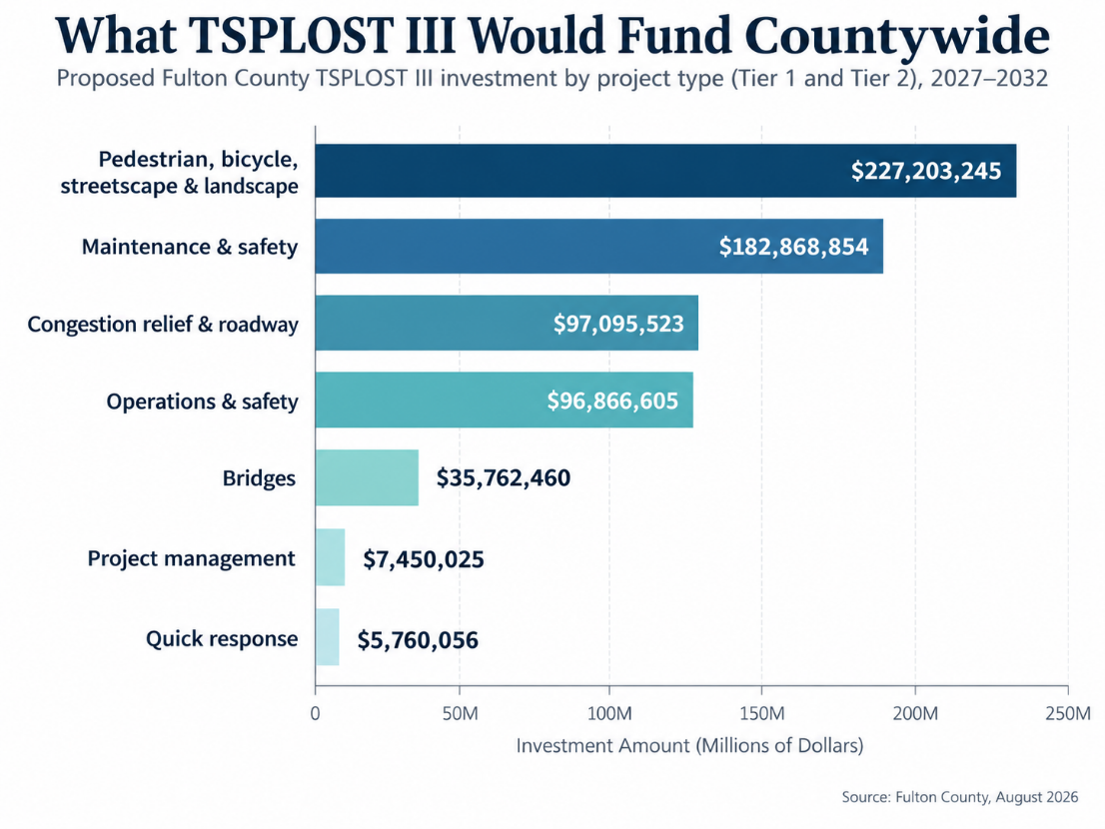
That mix reflects a broader change in what transportation investment means for a growing metropolitan region. Mobility today includes moving vehicles efficiently, but it also means maintaining existing assets, eliminating dangerous intersections, connecting trail networks, improving pedestrian access and creating more ways to move between employment centers and surrounding communities.
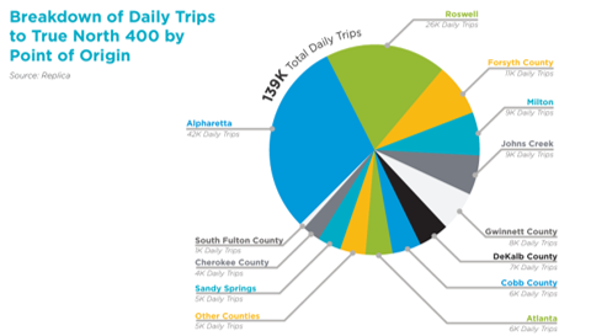
Because TSPLOST is collected through sales rather than property taxes, Fulton residents are not the only ones funding transportation infrastructure. The thousands of workers, visitors and shoppers who travel into the county and make taxable purchases also help pay for the roads and mobility improvements they rely on. In other words, we are asking non-Fulton residents who use our roads, cross our bridges and enjoy our sidewalks to help pay their fair share of the cost to maintain them. True North 400’s own breakdown below of daily trips to their commercial areas show how nearly 35% of visitors to those core commercial areas come from outside of North Fulton and would be contributing to the infrastructure investment.
North Fulton Shows What Layered Transportation Funding Can Accomplish
True North 400 offers a very successful example of why dedicated local transportation dollars matter, even when they are not the only dollars paying for a project.
Since its formation, True North 400 has leveraged more than $32 million of CID investment into more than $262 million in transportation and infrastructure improvements along the Georgia 400 corridor. That represents $8.19 of total project investment for every dollar of CID capital committed. That is a striking illustration of what public-private leverage can accomplish when local partners have resources to bring to the table.
Consider the Kimball Bridge Road multimodal connection. True North 400 invested approximately $1.1 million to complete a missing shared-use path between the City of Alpharetta's Kimball Bridge Road widening and GDOT's bridge work associated with the Georgia 400 Express Lanes project. It is a relatively small project compared with the multibillion-dollar Express Lanes program, but it demonstrates why local funding matters: the state can deliver a major regional investment while a CID and city ensure that the surrounding network actually connects to it.
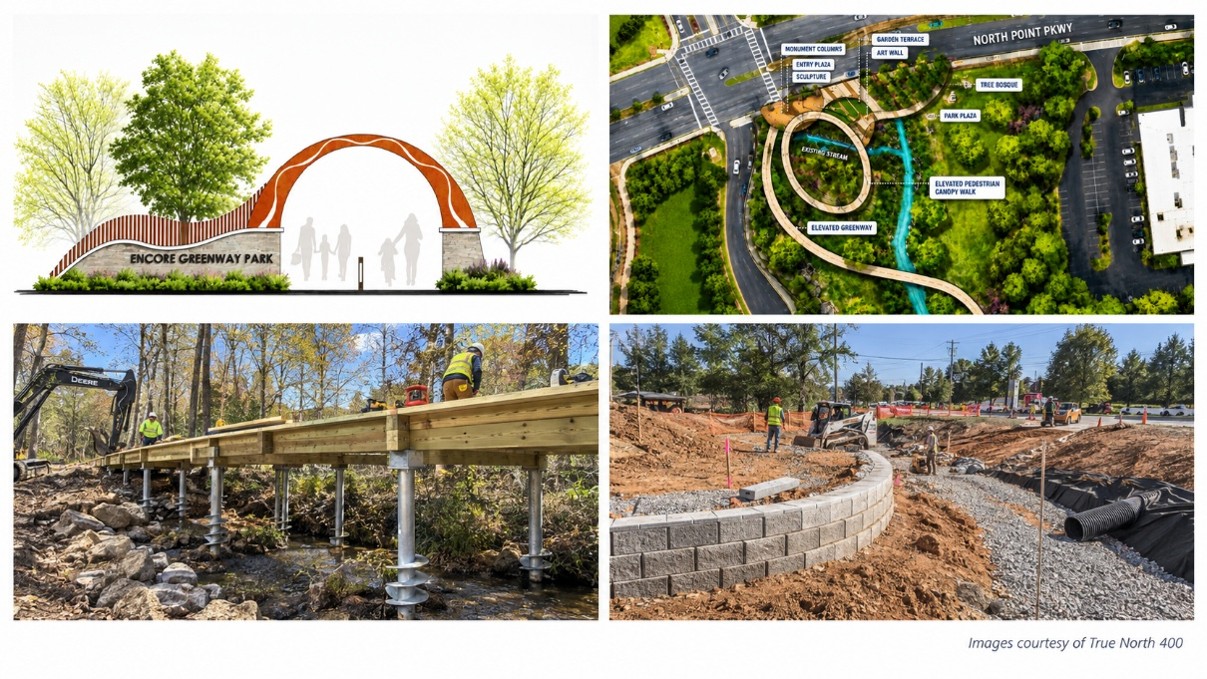
The same model can be seen at the Encore Greenway Park and Gateway, where True North 400 has committed approximately $1.93 million toward a $9.83 million project with the City of Alpharetta connecting the AlphaLoop and Big Creek Greenway. This is also reflected in the CID's ongoing MARTA bus-shelter program. It can also be seen in older projects such as the $17.9 million Encore Parkway Corridor Improvement, to which the CID contributed $6 million alongside Alpharetta, GDOT, ARC and the State Road and Tollway Authority.
Infrastructure Investment Is Economic Development
There is also a larger economic reason for taking transportation investment seriously.
The Atlanta Regional Commission's current Metropolitan Transportation Plan programs $168 billion in federal, state and local transportation investment through 2050. Sixty-three percent of that plan is devoted simply to maintaining and modernizing the system already in place. ARC's earlier forecasts projected that the Atlanta region will add about 1.8 million residents by 2050, which creates a challenge. The region must both preserve its massive transportation network and prepare it for continued population and employment growth. Keeping investment in TSPLOST ensures the region does not rapidly fall behind as more businesses and residents decide to make Metro Atlanta home.
Transportation investments also affect more than construction itself. A longstanding GDOT freight analysis estimated that an $18 billion to $20 billion package of statewide freight improvements could generate more than $65 billion in additional economic output over the study period, along with thousands of jobs. That study examined a much broader collection of freight projects and should not be read as a direct return-on-investment forecast for Fulton TSPLOST. But it quantifies an important principle: transportation capacity, travel reliability and access are productive economic assets, not simply government expenses.
Planning for the Transportation System North Fulton Will Need Next
North Fulton is not the same community it was when the first TSPLOST was approved in 2016. The employment market has changed. Major mixed-use centers have matured. Communities are placing greater emphasis on walkability and trail connectivity. The Georgia 400 corridor is entering a new era with the SR 400 Express Lanes project, and future express-lane transit creates new opportunities for first- and last-mile connections and redevelopment. True North 400 itself is already studying how areas such as Windward Parkway can evolve to improve pedestrian connectivity, access to employment centers and placemaking.
The transportation system must evolve with those changes.
For the Council for Quality Growth, that is ultimately the most important policy lesson. A successful transportation strategy is not a choice between state investment, local investment or private-sector participation. Metro Atlanta needs all three. It needs GDOT delivering projects of statewide significance. It needs cities making improvements to local streets and intersections. It needs federal and regional partners to bring additional capital into the region. And it needs CIDs such as True North 400 willing to invest private commercial-property tax dollars, develop projects and fill the gaps between larger public investments.
TSPLOST sits within that larger system. It provides locally controlled transportation funding that can address projects, large and small, respond to needs identified by individual communities, and serve as one piece of the funding partnerships through which North Fulton's transportation infrastructure is ultimately delivered.
On November 3, 2026, Fulton County voters outside the City of Atlanta will determine whether that existing 0.75% transportation sales tax continues for another five years. The voter-registration deadline for the general election is October 5, with advance voting beginning October 13.
Whatever project is being discussed — a state express lane, a bridge, a safer intersection, a multimodal connection or a few hundred feet of trail that finally closes a gap — North Fulton's experience demonstrates the same underlying reality: infrastructure gets built when communities have a plan, committed partners and the funding necessary to move that plan forward.